
What are ECTS Credits?
European Credit Transfer and Accumulation System (ECTS)
All Woolf (MT) degrees are issued with ECTS credits. ECTS accreditation is the most sophisticated, widely recognized accreditation system in the world.
ECTS allows credits taken at one higher education institution to be counted towards a qualification studied for at another. ECTS credits represent learning based on defined learning outcomes and their associated workload.
ECTS enhances the flexibility of study programmes for students. It also supports the planning, delivery and evaluation of higher education programmes.
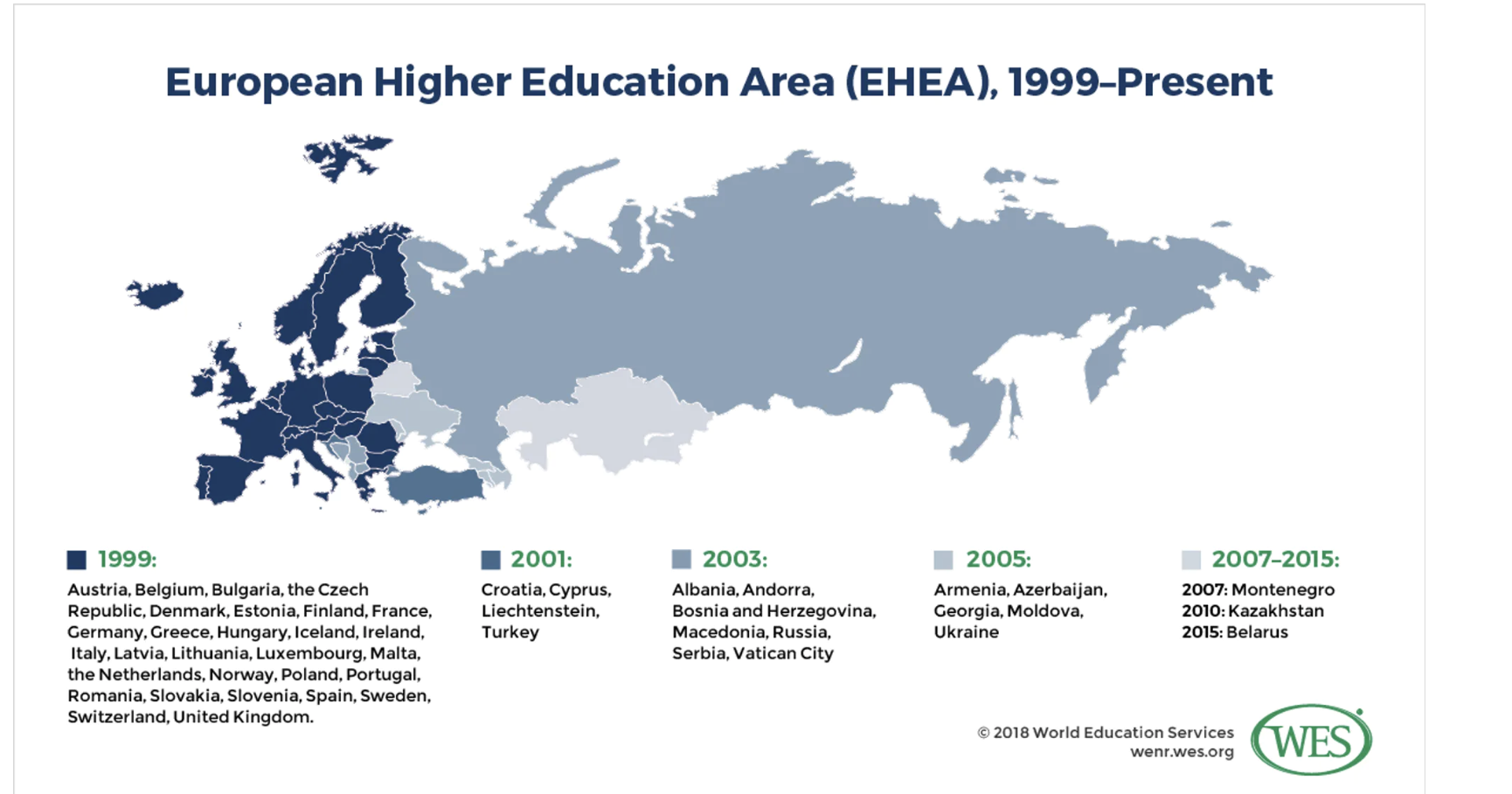
ECTS has been adopted by most of the countries in the European Higher Education Area (shown in the map below) as the national credit system and is increasingly used elsewhere.
How does it work?
60 ECTS credits are the equivalent of a full year of study or work. In a standard academic year, these credits are usually broken down into several smaller modules.
A typical 'short cycle qualification' typically includes 90-120 ECTS credits. A ‘first cycle’ (or bachelor's) degree consists of either 180 or 240 ECTS credits.
Usually a ‘second cycle’ (or master's) degree equates to 90 or 120 ECTS credits. The use of the ECTS at the ‘third cycle’, or Ph.D. level, varies.
Woolf's ECTS Statement
ECTS standards, following the European Standards and Guidelines 2015 (ESG 2015) are validated by an approved regulatory authority.
The Malta Further and Higher Education Authority (MFHEA), which is partially funded by the European Commission and European Union, implements ESG 2015 with the aim of further promoting quality in further and higher education. In September 2019, the Malta Further and Higher Education Authority (MFHEA) (previously the National Commission for Further and Higher Education (NCFHE)) licensed Woolf as a degree-granting, accredited, Higher Education Institution. This license is recognized within the European Qualifications Framework (EQF) and allows for transportability of higher education credits and degrees within the European Union. Malta is a member of the Bologna Process and the European Higher Education Area (EHEA). Programs with ECTS accreditation via Woolf are specifically designated as such. In Europe, Woolf is a Higher Education Institution and is not licensed as a “university,” which is a specially reserved term. As a licensed Higher Education Institution, Woolf is able to offer bachelor’s, master’s, and doctoral degrees with the same status as issued by a “university.” Woolf expects to add the title of “university” (a matter of prestige but not accreditation) as it increases its publishing outputs.