
Degree Mobility and Immigration
Woolf is an accredited higher education institution operating within the European Higher Education Area (EHEA). Woolf’s degrees are widely recognized across 60+ countries, benefiting from the Lisbon Recognition Convention, which ensures mutual recognition among 57 member nations. This robust recognition framework enables graduates to use Woolf degrees internationally, particularly in North America and Europe.
Key Points
Accreditation: Woolf aligns with the ECTS (European Credit Transfer and Accumulation System), the most widely accepted credit transfer system globally. This system is recognized by institutions in regions like the United States and Canada.
Automatic Recognition: Degrees issued in the EHEA are typically recognized among member countries. However, final recognition decisions are ultimately determined by individual countries.
Immigration: Woolf degrees have been successfully evaluated for immigration and academic equivalence in multiple countries, making them useful for residency, work, or further study applications abroad.
General FAQs
What is an Education Credential Assessment (ECA)?
An Education Credential Assessment (ECA) is a process used to evaluate whether a degree from one country is equivalent to a degree in another country. It is often required for both academic and immigration purposes to verify the value of foreign qualifications.
Types of ECAs
Academic Purposes: Used for further studies or employment in specialized fields.
Immigration Purposes: Evaluated by authorized agencies (especially in countries like Canada) to support visa applications.
Have Woolf degrees undergone an ECA for academic purposes?
Yes. Several Education Credential Assessment (ECA) agencies have reviewed Woolf’s master's degrees, deeming them equivalent to those from regionally accredited institutions in the United States.
What is an ECA for immigration purposes?
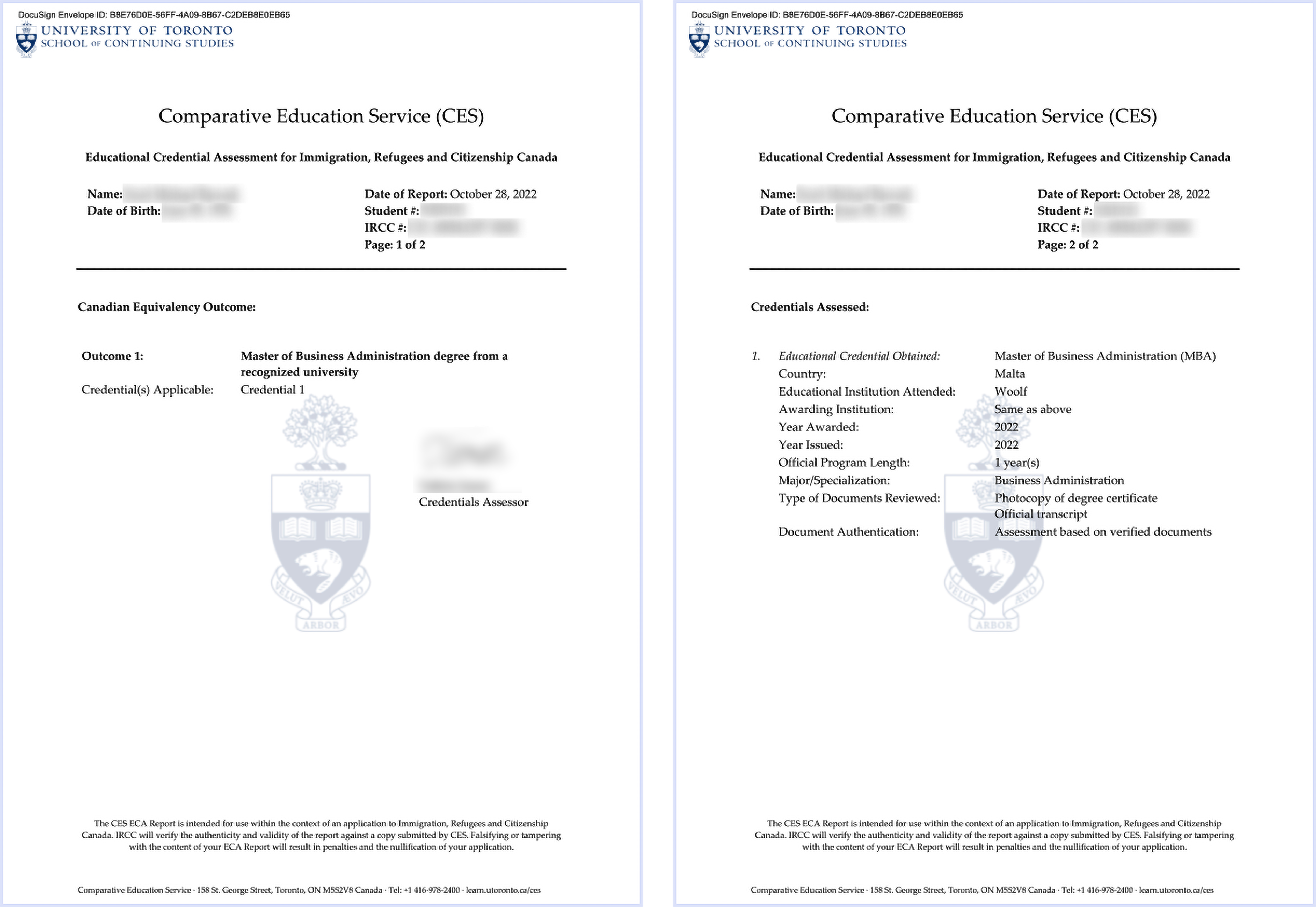
For immigration, some governments evaluate degrees directly, while others rely on third-party evaluators. In Canada, for instance, independent evaluators such as Comparative Education Services (CES) (part of the University of Toronto) perform these assessments. CES has recognized Woolf as a "recognized institution," which helps alumni with residency and citizenship applications.
The academic evaluation part may take 5-7 weeks, but full immigration assessments can take 10-30 weeks.
Read this for details and evaluations for additional countries.
Sample ECA certificate:
Will a Woolf degree help with visa applications?
Yes, a Woolf degree can support visa applications. While policies vary by country, Woolf’s accredited degrees are recognized in many jurisdictions and can potentially add points to immigration applications.
Can I use my Woolf degree to qualify for a PhD program?
Woolf’s degrees are accredited using the ECTS system and are designed to meet global academic standards. They generally fulfill the qualifications needed to enter PhD programs. However, individual institutions and PhD advisors may have specific entry requirements, so it’s recommended to check with the target program.
Is there a difference in accreditation between online and offline degrees?
No, in Europe, both online and offline degrees hold the same accreditation status. The mode of delivery does not affect the degree's recognition.
Can I verify Woolf’s accreditation on a government portal?
Yes, Woolf’s accredited programs, such as the MS in Computer Science, are listed on official portals like the Malta Further and Higher Education Authority (MFHEA). You can verify program listings here.
For more information on Woolf's accreditation status, visit Woolf's Accreditation Page.